Check out my Green-Wood sponsored tours on their calendar pages here. You can also find me on Bluesky here
Celebrate your inner nerd with my new t-shirt design! Available on my Spreadshirt shop in multiple colors and products.

Sunday, September 21, 2008

Interesting Sparrow at Riis Park

See update at the end of this post.

On Saturday I lead a trip for the Brooklyn Bird Club to Fort Tilden and Jacob Riis Park. The wind conditions were less than ideal for fall migrating birds, but there were some highlights, including a very oddly plumed sparrow.

Overnight Northeast winds switched to the east and by late morning were nearly non-existent. Flocks of migrating Blue Jays looked confused as they moved both east and west across Ft. Tilden and Riis Park, circling the area. The best sighting of the day was a female Dickcissel located at a stretch of grass near the boardwalk just east of Beach 169th Street. Seconds after spotting the Dickcissel, Tom Preston and I noticed an odd sparrow perched nearby. There were several Savannah Sparrows and Song Sparrows in the vicinity that flushed as we walked across the grass. This bird's general shape and structure was that of a Savannah Sparrow, but with muted colors that seemed odd and unfamiliar to me. It had the yellow facial wash one would expect on most savannahs, but, among other interesting features, had an unusual buffy-colored collar. The "Ipswich" Sparrow race of savannah is very pale, but should be noticeably larger than our typical race. James Rising's "A Guide to the Identification and Natural History of the Sparrows of the United States and Canada" mentions that there are 12 subspecies of Savannah Sparrow, so perhaps it is just a form that is uncommon around New York City. I've also considered that perhaps this individual bird has a pigment deficiency. Jason Conradt and Steve Walter were present and took some decent photographs of the bird. If you have any insights, I'd appreciate your comments.


A big thank you to all the people who took the time to write me with their opinion of this interesting sparrow. All were of the opinion that it was, as I suspected, a leucistic Savannah Sparrow. Peter Post gave a more technical explanation than others:

"The sparrow looks to me like an erythristic Savannah Sparrow. That is an individual showing only the Phaeomelanin (red) pigments and lacking eumelanin (black pigment)."

I really enjoyed the following, surprising email exchange sent to me by Jason Conradt:

From: Jason Conradt
Subject: Fwd: Savannah Sparrow question


Hey Rob,


On a lark I thought I'd email David Sibley and see what he thought. He thinks it might be leucistic. This is a fun little mystery.

-Jason
* * * * * * * * * * *

On Sep 21, 2008, at 9:31 PM, Jason Conradt wrote:


Hi Mr Sibley.


I'm a birdwatcher from Brooklyn, NY (Chelmsford, MA originally) and I've stumbled across a sparrow I can't identify. I think it's an Ipswich Sparrow but the dark streaks in the primary and covert feather tips are very pale. I was wondering if you thought this could be a partial albino or possibly another variant that isn't illustrated in your book.


I saw the bird on a walk led by Rob Jett of the Brooklyn Bird Club at Fort Tilden. I attached some photos that I took and you can check out my Flickr page if you're interested in seeing more of them. If you have time please let me know what you think.


My wife and I love your books.


thanks,

Jason Conradt

* * * * * * * * * *

From: David Sibley

Date: September 22, 2008 9:36:38 AM EDT

Subject: Re: Savannah Sparrow question


Hi Jason,

From the photos I would say this is NOT an Ipswich, too much yellow on the face and too much red in the wings and body. Ipswich should look grayer overall with hints of pinkish, and virtually no yellow on the face. So this is most likely to be a "dilute plumage" or "leucistic" Savannah from one of the common subspecies, lacking some of the brown or black pigment. Interesting bird.


Best,
David
by Rob Jett for "The City Birder"

Wednesday, September 17, 2008

Tom Davis Shorebird Walk

I began this piece the day before my accident, so forgive me if it seems a few weeks late.

There was a period of time when ornithologists and birdwatchers believed that the only way to properly identify some shorebirds was to shoot them. Once in the hand, close inspection of the feathers, bill and other field marks could be correctly measured and analyzed. Much has changed over the last 50 years. Teacher, artist and naturalist Roger Tory Peterson lead the way with his systematic approach to identifying birds in the field. Other biologists and artists soon followed Peterson. Thankfully, now binoculars and spotting scopes have replaced the shotgun. For myself and many birderwatchers, though, identifying some shorebirds remain a challenge. While there is no substitute for spending time in the field observing shorebirds, a good teacher is, in my opinion, key. Regarding shorebird identification, Jack Connor, author of "The Complete Birder", wrote:

"Warblers and hawks can be exasperating; shorebirds can be ego crushing.

Warblers and hawks generally escape us by dropping into the bushes or flying over the horizon, so there's always bad luck to blame: "At first I couldn't see it, then it disappeared." Too often in shorebirding, the unident stands right there, thirty yards away, waiting patiently while we first flip through our field guide, then backward more slowly, checking all the plumages, then forward again, this time being sure to check the pages with the Eurasian vagrants, and it's still standing there when at last - meekly and painfully, hoping no one is watching - we close down the scope and walk on."


Last year I posted a couple of short pieces about a celebrated New York City birder named Tom Davis. You can read them here and here. I never met Tom as he passed away long before I began birding, but Peter Post kindly sent me two photos from back in the '60s or '70s. I had heard that Tom was tall, but after seeing the photos, I think "towering" would be a better description.

I mention Tom Davis for two reasons. First, it is my understanding that Tom was not only a skilled, passionate birder, but also a great teacher. Shorebirds were his specialty and he went to great lengths to find, identify and share with others his discoveries, understanding and love of these long distant migrants. His name is attributed with many of the state's records of rare shorebird sightings. For many of New York's long time birders, it is difficult to discuss "Jamaica Bay Wildlife Refuge" and "shorebirds" without recalling a Tom Davis anecdote. I'd like to learn more about Tom and help keep his legend alive. As with last year's posting, perhaps readers who knew him could add a brief mention in the comments section.

Birding, as a recreational activity, has a tradition of passing on knowledge to the next generation of birders. From my perspective, birding is not just about finding birds, it's also about sharing. Sharing my enjoyment of nature discovery was my motivation for creating this blog. In the spirit of Tom Davis' love of shorebirds, for the last 15 years the Linnaean Society of New York has hosted an "Annual Tom Davis Shorebird Walk" at Jamaica Bay Wildlife Refuge. This year the walk was on August 23rd. For the 5th consecutive year, my good friend Sean Sime was the trip leader. Tom Davis is a tough act to follow (especially at 6' 8" tall), but Sean's detailed knowledge of shorebirds, relaxed demeanor, excellent teaching skills and sense of humor always make for a good trip.

In the weeks prior to the walk, circumstances that only the birds would know (and they're not talking) lead to an unusual appearance of rare birds at the refuge. I suspect that most people who attended the walk had high hopes that there would still be some of these rarities present. I knew that it had been a while since the Red-necked Stint, Sharp-tailed Sandpiper and Wilson's Phalarope were reported at Jamaica Bay, but would be just as happy to spend my time studying the more common "peeps." I welcome any opportunity to learn more about identification from Sean, whether the shorebirds are rare or common.

Our group met at the visitor's center a couple of hours prior to high-tide. Sean's strategy was to have enough time to bird the West Pond area, then walk to the East Pond at the peak of the tide cycle.

There weren't any unusual birds observed that day, but it did allow us to spend time learning more about the "peeps" conundrum - Least Sandpiper, Semipalmated Sandpiper, White-rumped Sandpiper (and, if they were present, Western Sandpiper and Baird's Sandpiper). The "best" shorebird of the day was a trio of Stilt Sandpipers seen on the East Pond.

For me, one of the more enjoyable aspects of watching birds, is observing their behavior and we had an interesting experience that day. As our group was exiting the South Flats section of the East Pond we spotted something fascinating. Several groups of migrating swallows had been seen flycatching over both the West and East Ponds. They were primarily Tree Swallows, but there were also a small number of Bank Swallows present. At the south end of the East Pond I pointed out a Bank Swallow to some of the birders who had missed it earlier. As we were watching the bird, it dipped down towards the surface of the pond and picked up a white feather floating on the water. The bird carried the feather several yards into the air, then released it. As the feather fluttered towards the pond, the acrobatic swallow swooped down and caught it. It repeated this apparent game of catch several times as our group looked on in amazement.

We discussed the possible motivation for its behavior. Some people thought that it might be a young bird who was practicing his or her insect hunting mastery. It sounds plausible. Perhaps play IS sometimes an activity that hones an animal's survival skills, but just as humans enjoy playing, could it also be that sometimes play is simply just fun even for birds?
-
Location: Jamaica Bay Wildlife Refuge
Observation date: 8/23/08
Notes: 15th Annual Tom Davis Memorial Shorebird Walk
Number of species: 57

Gadwall
Blue-winged Teal
Green-winged Teal
Double-crested Cormorant
Great Blue Heron
Great Egret
Snowy Egret
Little Blue Heron
Black-crowned Night-Heron
Yellow-crowned Night-Heron
Glossy Ibis
Osprey
Broad-winged Hawk
Peregrine Falcon
Black-bellied Plover
Semipalmated Plover
American Oystercatcher
Spotted Sandpiper
Greater Yellowlegs
Lesser Yellowlegs
Ruddy Turnstone
Red Knot
Semipalmated Sandpiper
Least Sandpiper
White-rumped Sandpiper
Stilt Sandpiper
Short-billed Dowitcher
Long-billed Dowitcher
Laughing Gull
Great Black-backed Gull
Common Tern
Forster's Tern
Chimney Swift
Fish Crow
Tree Swallow
Bank Swallow
Barn Swallow
Carolina Wren
Gray Catbird
Red-winged Blackbird
Boat-tailed Grackle
Brown-headed Cowbird
American Goldfinch

Other common species seen (or heard):
Canada Goose, Mute Swan, American Black Duck, Mallard, Ring-billed Gull, Herring Gull, Rock Pigeon, Mourning Dove, American Crow, American Robin, Northern Mockingbird, European Starling, House Finch, House Sparrow

by Rob Jett for "The City Birder"

Tuesday, September 16, 2008

Some Splainin'

On the classic television comedy "I Love Lucy", Lucille Ball's character was forever finding herself entangled in some kind of mess. Her husband, Ricky, would more often than not, catch on to her situation and demand in his heavy Cuban accent, "You have some splainin' to do." Well, after a three week slow down, I think it's time for me to do some "splainin".

I love the ocean. As my mother tells it, I was a regular water baby and hard to keep out of the surf, pool, lake, you name it. My preference is for the ocean, though, because I love the waves. When I was in Junior High School, I would take the bus from Queens Boulevard, in Rego Park, to Rockaway Beach on the weekends. I never got into board surfing, but I loved bodysurfing, no doubt for the same reasons that seals enjoy it.

As some people get older, they tend to set aside the fun things of their youth. During my High School years I discovered recreational cycling. I was one of a small circle of friends who pedaled all the time, some of it long distance. My friend Roger and I twice rode from Forest Hills, in Queens, to Orient Point, on the north fork of Long Island. Of my cycling buddies from that period, I am the only one still riding. Roger, I was told, gave up bicycles for motorcycles.

I also never retired my love for bodysurfing. Without the use of a surf board or boogie board, zipping through the water using just my body to navigate is a joyful, almost euphoric experience - most of the time. Which brings me to 3 weeks ago.

On Sunday, August 24th, Hurricane Faye was in the Atlantic Ocean somewhere due south of New York's barrier beaches. The night before I decided I wanted to race my wife to the beach. She would take the subway to the bus and I would cycle down to the beach. We would meet by the Wise Clock.

I gave her a 10 minute head start to get to the subway before I took off. Despite a slight headwind, the weather was perfect for riding. The last stretch before the beach is the Gil Hodges Bridge. While I was crossing it, one of the beach buses passed me by. Damn. Just as I pulled onto the boardwalk my cellphone rang, the voice on the other end said, "I just got off the bus." We got to the clock at the same time.

The waves were huge and coming straight in towards the shore. By high-tide they were breaking about 20 yards from shore and in fairly deep water. Nice. I spent most of the afternoon riding the best body surfing waves of my adult life. Riding most of the same waves was a tattoo-cover man about my age next to me. He was also having the time of his life. At one point he said to me, "My kids are bored and want to go home, but these are the best waves I've ever seen at Riis Park, so they're gonna hafta wait." We must have looked like two overgrown kids. Finally I decided it was time to dry off and get ready to pedal back to Park Slope.

When birding, I tell people that there's always one last bird, so if I'm exiting Prospect Park, I'll stop and look around before crossing the street and going back into the neighborhood. On August 24th, I decided that there was one last wave to ride, turned around, dove through a breaker and waited for the next big one. It came, alright, and I messed up big time, waiting too long to pull out of the break, and got clobbered. I was tossed around like a pair of boxer shorts in the spin cycle of a washing machine, then slammed, shoulder first, into the sandy bottom. I immediately knew something was wrong when I stood up and touched my shoulder. It felt like my arm was hanging down a few inches lower than normal. Then I felt a large bump on my collar bone ... Yes, the adjacent image is my actual x-ray and you don't need to be a doctor to find the fracture. Ouch.

The good news is that I didn't break my neck, the bad news is that I did break my collar bone. Oh well, what can I say except crap happens. For this type of injury there isn't a whole lot, medically, that can been done. I'm supposed to relax, ice it, keep my arm in a sling and be patient. My doctor promised that I should be back to normal (or as close as I ever was) in 6 to 8 weeks. Thankfully, I can still use my binoculars with two hands, but it does get real painful after a while. I need to limit myself and know when to stop and go home. I'm sure that anyone who knows me will likely laugh when they read that "note to self". As for my future in the professional bodysurfing circuit, I think that dream is over, but come next summer, I'll still be out in the surf with one other crazy old man.

I've been birding a few times since my accident and have a bunch of photos and sightings that I'll try and post by the end of the week.

by Rob Jett for "The City Birder"

Saturday, September 06, 2008

Dale Dyer Drawings and Paintings

My friend Dale Dyer is having a showing of his bird drawings and paintings at Ursus Books & Prints, Ltd. In addition to being a talented artist, Dale is an excellent birder. In fact, he was the first birdwatcher that I met when I began looking at birds in Prospect Park. I remember it as if it was yesterday; he was extremely helpful, pointing out for me the subtle differences between some of our woodland thrushes.

Learn more about Ursus Books & Prints, Ltd. here.


by Rob Jett for "The City Birder"

Friday, September 05, 2008

New Maps Feature

Let me know what you think of the new maps menu in the sidebar. Eventually, I'll have pulldown menus for each of the five boroughs.

by Rob Jett for "The City Birder"

Wednesday, September 03, 2008

Birding Trip in Prospect Park

UPDATE:

I just got off the phone with Anne Lazarus of the field trip committee. She agreed that, to avoid possibly flood conditions, it would be wise to move the walk from Saturday to Sunday. So ...

(hurricane tracker link)

This coming Sunday, September 7th, I will be leading a birding trip in Prospect Park. The trip is organized by the Linnaean Society of New York. There is no registration necessary and we meet at Grand Army Plaza in front of the Stranahan Statue at 7:30am. The statue is next to the path at the northeast corner of the park entrance.

My trip is a casual stroll through, primarily, the wooded areas of the park in search of migrating songbirds. Anyone familiar with my tours (and this blog) can expect some of the trip's focus to include wildflowers and insects. The length of the trip is flexible and I usually base it on the weather, productivity and people participating. You can bring lunch and a snack, but there is also a limited selection of food and beverages at the boathouse nature center.

If you are the chronically late type, leave yourself extra time because I like to begin my trips promptly. The closest subway stations to Grand Army Plaza are:

2 train - Grand Army Plaza
B train - 7th Avenue/Flatbush Avenue
Q train - 7th Avenue/Flatbush Avenue

Hope to see you Sunday.

by Rob Jett for "The City Birder"

A Question about Migration

Following my most recent posting, I received a question regarding birds that migrate through New York City.

First, I apologize to anyone who posts a question if their comment does not appear on the blog right away. When I am out of town I don't always check my blog. Since I've been forced by spammers to moderate all incoming comments, I need to manually check all incoming comments, then decide to "Publish" or "Reject".

Marie asked, "...don't the birds have to stop, to rest, eat, sleep, before they reach the Gulf of Mexico? I keep trying to incorporate bird-friendly plants into my rooftop gardens but perhaps I am mistaken in thinking that many of the them rest in the city?"

Most birds, with a few exceptions, do need to stop, rest and refuel at various points along their migration route. It is for that reason that urban parks, backyard gardens and roof gardens are so important to these animals. Renewed interest in roof gardens is great on many levels, from moderating urban heat island effects to creating oases for migrating birds. I hope I didn't give the impression that migratory species don't rely on NYC parks and gardens for help. They certainly do. Marie and anyone else designing gardens for wildlife shouldn't change their sales pitches, birds can always use our help.

Biologist Scott Weidensaul wrote a great book entitled, "Living on the Wind, Across the Hemisphere with Migratory Birds." He explains and follows the routes that some of these long distance migrants make twice a year. A large percentage of the neotropic songbirds that we see in the northeast are trans-Gulf migrants, which means that the non-stop portion of their flight is between the Yucatan Peninsula and the coast of Louisiana. Some Blackpoll Warblers will fly for 40-50 hours over the western Atlantic Ocean on their southbound journey. Many, however, stick close to the coast and can be seen in our local parks during migration. A contender for the "Most Incredible Fall Migration by a Bird" Award is a large shorebird called the Bar-tailed Godwit. They will fly from their nesting grounds in Alaska to their wintering grounds in New Zealand, a flight that can easily last 4 to 5 days, without resting! They can't swim, so stopping for a dip in the Pacific Ocean would result in drowning. In my warped mind, I imagine a family of godwits heading south, with one juvenile, smart-assed godwit at the back of the flock making his first trip. He might be sounding a lot like Bart Simpson - "Are we there yet? Are we there yet? Are we there yet? Are we there yet? Are we there yet? Are we there yet ..."

by Rob Jett for "The City Birder"

Monday, August 25, 2008

Orient Point and Continuing Migration

One of my younger brothers owns a weekend house on Orient Point. Orient is at the eastern tip of the "north fork" of Long Island. It is across the Long Island Sound from the coast of Connecticut and a virtual migrant trap for birds heading south. I was hoping to catch a glimpse of some of those birds.

Flocks of migrating birds head for the narrowest crossing when faced with open water. Montauk Point, on the south fork, is a known location to spot birds heading south and I've traveled out there several times in the past. I've never been to the end of the north fork to look for birds, but assumed it would also be a good location. A short distance from the end of Orient Point is Plum Island. Between the two small points of land are rip currents dotted with rocky outcroppings and accented with sharp, rolling white-caps. Exposed boulders were the exclusive domain of gulls and an occasional shorebird.

The Saturday morning after my arrival, I took an early morning walk down the beach to the end of the point. There was a near constant chatter of Tree Swallows flying overhead. Closer to the surface of the water I spotted small flocks of "peeps", a few Willets, several Ruddy Turnstones, a few oystercatchers and three or four Spotted Sandpipers. Also part of the full moon migration, and a bit disturbing, were rafts of Lion's Mane Jellyfish. I grew up close to the shore, so seeing these stinging animals in August isn't unusual, but the abundance was extraordinary. Like a red tide, the jellyfish stretched along the break as far as I could see. It would have been impossible for a person to swim without receiving multiple stings!

At the point, I observed flocks of swallows coming in from across the water. Their numbers ranged from a few dozen at a time to a couple of thousand individuals in a flock. Once they were clear of the water, they just continued flying southwest. Later that morning I spotted a Northern Waterthrush that had landed in a wooded stretch at the edge of my brother's backyard. I pointed out the warbler to my brother and his wife, but they seemed unimpressed by the small, brown bird. The fact that this 18 gram bird was likely headed to South American sparked a little bit interest, but not the level of enthusiasm to which I am inclined when I learn about the feats of such tiny creatures.

On our drive back to Brooklyn on Sunday I noticed something amazing. The north fork of Long Island has not suffered the endless development of the south fork. Most people are familiar with the sprawling mansions of the hamptons and Dune Road. Fortunately, the potato farms of the north fork that I remember from my childhood summers in Cutchogue have been replaced with vineyards, not mac-mansions. The views along the old Middle Road or Soundview Road, for the most part, are of grape vines and open fields, not shiny, new developments. We left Orient Point at about 6pm and, as we drove west, I noticed that we were keeping pace with flocks of swallows and blackbirds. Many of those birds will pass Brooklyn and New York City and not stop until they reach the Gulf of Mexico. Some will continue following southwest, along the coast, while others will head straight out over the water. How they make that trip twice a year is nothing short of a miracle.

by Rob Jett for "The City Birder"

Summer is Nearly Gone

It's been nearly 6 years since my cycling accident. Two surgeries, uncounted hours of physical therapy and, this year, I've finally returned to regular rides. Moving along on a bicycle may be ten times faster than walking, but it doesn't preclude nature observations. They are just very brief.

My preferred route this summer takes me through residential areas south of Park Slope and to Jacob Riis Park, where I briefly swim before heading back north. Last Thursday, after work, I took a quick ride. At the intersections of Argyle and Elm Streets, a car creep past the stop sign and into my path. I can make an obnoxiously loud, bicycle messenger-like whistle, so I let loose a squealing "wheet, wheet". A few seconds later, from an opened window in a house to my right, came a parrot's mimicked "wheet, wheet". I heard a second call as I flew passed the row of two story homes. I chuckled and wondered if I had inadvertently added to someone's parrot's repertoire of calls?

The most noticeable changes along my route has been among the trees. From Prospect Park to Marine Park, Norway Maple are releasing their helicopter-like seed pods, or keys. Oaks are already dropping acorns. When I run them over, they either get crunched or launched from between my tires and the road, pinging off of the sides of parked cars. Black Cherries have fully ripened and, the ones that don't get eaten by the birds, tattoo the roads and sidewalks beneath the trees. My tires bear purple stains from the cherry juice colored pathway at Flatbush Avenue where it passes over the Belt Parkway. Pagoda Trees, the last flowering trees of the summer, has sprinkled many streets with their golden yellow, popcorn blossoms.

The Dog-Day Cicada's churring songs now dominate the summer sounds. Near the corner of Church Avenue, the chainsaw-like crescendo of cicada calls owned the airwaves, out performing even the Hip-Hop back-beat coming from pounding woofers in a parked car.

Flocks of Sanderlings have been increasing in abundance along the beaches. Fort Tilden and Riis Park seem to be a staging area for the migrating shorebirds. This last week saw the greatest increase. As I was watching some of these tiny, gray and white birds chasing the edge of the surf in search of food, I noticed something curious. Many individuals periodically assumed an aggressive posture when near another bird. They'd lower their heads, hunch their backs and face off like a pair of Sumo wrestlers. Where are the cute, peaceful birds that I am accustomed to seeing in large, cooperative flocks along the shore during winter months? Maybe they are still cranky from the long flight south.

At Bay 8 beach, an adult oystercatcher provided shade for a very young hatchling. At this time of year, most American Oystercatcher offspring have fledged. Perhaps this individual is the result of a second or third brood. It is so late in the season, I hope it survives.

by Rob Jett for "The City Birder"

Wednesday, August 13, 2008

I Thought We Had a Deal

Fans of the television sitcom "Seinfeld" might remember the line, "I thought we had a deal." It was a classic episode in which one of the story lines involved George Costanza accidentally hitting with a car, or stepping on, pigeons. He explains the first encounter here:

"JERRY: You ran over some pigeons? How many?
GEORGE: What ever they had. Miranda thinks I'm a butcher but i-i-it's not my fault is it? Don't we have a deal with the pigeons?

JERRY: Course we have a deal. They get out of the way of our cars, we look the other way on the statue defecation.

GEORGE: Right! And these pigeons broke the deal. I will not accept the blame for this!"


Today I felt like George, the only difference was that I was cycling. Like most New Yorkers, unless one is being eaten by a hawk or falcon, I pretty much ignore pigeons on a daily basis. When I'm cycling, if there are any in my path, I rarely apply my brakes as they always move out of the way. Well, almost always.

I was near the Parade Grounds pedaling up Argyle Road when I approached a flock of about six pigeons standing in the middle of the street. Five flew out of the way while I was still several yards away from them, the six hesitated. At the last moment he flew towards the parked cars, but I clipped the back end of the bird with my front wheel. Birds are surprising light weight and I didn't feel a bump or any vibration up through the bike frame. I looked to my right in time to see the bird spin 180 degrees and hit the tire of a parked car. In seconds, he righted himself, then flew off to join the other five birds.

They say that New Yorkers are a tough lot, but I think New York pigeons win the prize for surviving a daily barrage of automobiles, bicycles, dogs, pedestrians and, of course, birds of prey. At only 9 ounces, the lowly Rock Pigeon not only survives, but seems to thrive in the "City that never sleeps". I may have to rethink the whole "deal" thing.

by Rob Jett for "The City Birder"

Tuesday, August 05, 2008

Shorebirds Returning South

Sorry for the long delay between posts. My Internet service was down for a few days and we also had a house guest for a week. Add my chronic procrastination to the mix and I have had images and videos uploaded for a while, but no text to publish. That said...

It really feels like summer, but fall migration is well underway. Last Friday (August 1st) Doug, Shane and I went over to Jamaica Bay Wildlife Refuge to check out the shorebird migration. Water levels on the East Pond had begun to recede (naturally and by the opening of the valve on the north end), creating a narrow ring of shoreline between the water and encircling phragmites.

At this time of year there is a predictable cycle of activity on the refuge's ponds. The shorebirds forage for insects and tiny marine invertebrates on the exposed islands, mudflats and bars in the bay at low-tide. When those areas are flooded at high-tide, many fly over to the East and West Ponds of the refuge to rest along the shoreline or to continue feeding.

The brevity of most shorebird's breeding season is astounding. Many of the various species of shorebirds or waders are long distance migrants. They spend their winters in Central or South American. Come spring, they fly to breeding grounds within the nearctic, thousands of miles away.

Out of curiosity, I began to search through reference guides to locate data on how much time one of these species of shorebirds might spend traveling and how much time they remain on their nesting grounds. Over a dozen species of shorebirds might pass through New York City during a busy migration period, one is the Semipalmated Plover.

Semipalmated Plovers winter as far south as Argentina and, according to "Bull's Birds of New York State", begin to arrive around New York in late-April. After a short respite, they continue north to find a mate and nest somewhere within the south tundra. The females will lay a clutch of from 3 to 4 eggs that hatch in a little under a month. The fairly independent hatchlings fledge about 3 to 4 weeks later. Like the frantic rabbit from Alice in Wonderland, the impatient adult shorebirds rush off on the return trip before their offspring attempt the flight. Early returning Semipalmated Plovers can be observed at Jamaica Bay Wildlife Refuge by mid-July. So, on average, a Semipalmated Plover spends around 6 weeks on their nesting grounds.

I used Google Earth to measure a point along the coast of Argentina within these bird's known winter range, to a point near Hudson Bay within their known breeding grounds. The straight line distance was approximately 7,500 miles. An individual bird making that trek would more likely follow the coast, so the distance would in reality be greater. Conservatively, it could take 2 weeks to get to the tundra and 2 weeks to get back, so that's a month of flying. Using my unscientific estimates, that means a Semipalmated Plover could spend around 10 - 12 weeks just traveling or raising their young. The bad news is that they don't receive any frequent flyer mileage. The good news is that the world population of Semipalmated Plovers doesn't seem to have suffered from this grueling schedule. The better news (for birders, anyway) is that sometimes nearctic breeding shorebirds inadvertently stray from their normal routes. For example, if a Siberia nesting shorebird heading south towards its wintering grounds in Australia veers a little to the right or left, it can end up somewhere along the coast of North America. Such was the case last week at the East Pond of Jamaica Bay Wildlife Refuge.

On that Friday morning Shane met me up in front of my apartment at 6:15am, we picked up Doug, then the three of us headed off to Jamaica Bay Wildlife Refuge. It was just after sunrise and I was really excited as it would be my first day of the 2008 Fall shorebird migration. Both Doug and Shane had already spent a few days birding at the refuge's East Pond and reported increasing numbers of Semipalmated Plover, Greater Yellowlegs, Lesser Yellowlegs, Semipalmated Sandpiper, Least Sandpiper and Long-billed Dowitcher, to name a few. A pair of rare Wilson's Phalarope were also present. There was a cool, steady breeze blowing in from the north, making it feel more like late-September than early-August.

Access to the north end of the East Pond is through a narrow, 100-yard path cut through a dense jungle of common reed. The trail fans out onto a muddy, sulphurous viewing area at the northwest corner of a, roughly, rectangular 1 1/4 mile long pond. Rubber boots are necessary to travel south along the edges as the water level is still relatively high and mud, absolutely deep.

Flocks of chattering, peeping Semipalmated Sandpipers, Least Sandpipers, yellow-legs and dowitchers were feeding in shallow water adjacent to the trailhead. One, nearly all white, shorebird turned out to be a Wilson's Phalarope that was found earlier in the week by Doug and Shane. Phalaropes have several interesting feeding techniques, but one sets them apart from pretty much all the other shorebirds. Using their lobbed feet as paddles, they spin around in a circle, like a circus performer, stirring up insect larvae or arthropods then snapping up the food from the surface of the water. It's pretty funny to watch, but I probably shouldn't laugh at them as we likely look similarly amusing to them when we eat spaghetti.


We continued walking south, along the west side of the pond. The water level still reached the reeds in most places. There's a small cove next to a point on the map labeled "Sanderling Point". It not very wide, but needs to be navigated carefully if one wants to bird more than just the northern quarter of the pond. By the end of August it's surface is hardened, dark gray mud etched with deep cracks, but it was August 1st and we had to choose our steps carefully or sink to our waists in muck. South of the cove there were several mixed flocks of shorebirds spread out along a dry stretch between the water and phragmites.

After carefully crossing to the south end of the cove, we set-up our scopes to pick through the birds. Bob Kurtz, a long time New York City birder, was the only other person at the pond. Doug, Bob, Shane and myself spent about 2 hours scanning the large flocks of birds from the west side of the pond before walking back towards the cove. It had been a very good morning for abundance and diversity of birds, especially considering that we never went anywhere else in the refuge. At least I was happy.

Most people who know him, would agree that my friend Shane is an exception birder. He is careful, knowledgeable and always telephones people whenever he finds something special in the field so that they can get to see it. He is going to hate me for posting this on my blog, but he is also the most competitive person I know. Now there is a point for me mentioning this with regard to Friday's birding. As Bob, Doug, Shane and I were walking north, ostensibly to leave the refuge, Shane commented, "I can't believe we didn't find a stint." He sounded seriously disappointed, despite the fact that stints are rarely found at Jamaica Bay Wildlife Refuge or anywhere in the state. They are an Eurasian species of shorebird that has been observed in New York State five times since 1985. Apparently, Shane wanted to see the sixth.

We had stopped briefly, just short of crossing back over the cove. Bob, Shane and I were yapping about something, while Doug scanned the other side of the narrow stretch of water. Suddenly Doug said something like, "Hey guys, there's a really bright red shorebird in front of us." I swear I could hear the wind from Shane's head as he spun around to focus on the bird. It was unlike any sandpiper I had ever seen. Bob said it was a stint. Doug, Shane and I looked in our field guides. Bob repeated that it was a stint, a Red-necked Stint. We couldn't believe our luck and wanted to make absolutely certain of the bird's ID. I think we all knew pretty quickly, as it was in very bright breeding plumage and would be difficult to mistake for anything else. People would be dropping everything to come look for this bird and we didn't want to disappoint (or look like idiots). Doug, Shane and I went back and forth for a few minutes, checking field marks, before turning to Bob, who replied, once more, "It's a Red-necked Stint." Bob was the only one among the four of us who had ever seen one, in fact, he'd seen several.

The bird eventually flew across to the east side of the pond where it fed along a stretch of shoreline just north of a small island. Several phone calls later, the word was out and people were already in their cars heading towards the refuge. Over the next two days a couple of hundred people would make the trek to the East Pond of Jamaica Bay Wildlife Refuge to see the brightly colored sandpiper from Siberia.

Video by Doug Gochfeld


Saturday was pretty much a lost day for me. My wife's 15 year old nephew was flying in from North Carolina to spend a week with us. The flight kept getting delayed, it finally landed but they didn't have a gate, you know the routine, but I shouldn't complain because at least I wasn't the one stuck on the airplane.

On Sunday morning I received a phone call from Doug. He was back out at the refuge on the East Pond. In his usual, high-speed, mumbled style I heard the words "sandpiper" and "sharp-tailed". He slowed down enough for me to understand that the Red-necked Stint was still at the refuge, but there was now also a Sharp-tailed Sandpiper present. This shorebird species has only been seen at the refuge once. Apparently, the stint wasn't the only bird in Siberia that was directionally challenged. I told my nephew, Brandon, that after breakfast we would be taking the subway out to Jamaica Bay Wildlife Refuge. I also warned him to prepare for a total birding "geekfest". It was the weekend, the weather was beautiful and there was, not only an abundance of common shorebirds, but two extreme rarities on the East Pond.

Brandon is not into birdwatching, but I figured what 15 year old boy wouldn't mind spending the morning slogging around in the mud. During breakfast I had three field guides spread out on the kitchen table. I gave him the short lesson on shorebird migration and vagrants before we headed out towards the subway station.

I don't always chase rare birds, in fact, during my 2006 "Big Year", I think I probably burned out on that aspect of birding. This was different, though I'm not sure why. Perhaps it was that the season had just begun and I was still excited about the flood of arriving migrants. When Brandon and I walked onto the East Pond there were already about 50 birders present. As we hustled south towards the group still watching the Sharp-tailed Sandpiper, I did something that I'm ashamed to admit.

Several yards into the walk, I noticed the Wilson's Phalarope spinning in the shallow water. I pointed and said, "There's the phalarope" and kept walking. Just short of the curve in the shoreline near the cove, I stopped to scan the opposite shore for the stint. I got it in my scope almost immediately, looked at it for about 10 seconds said, "stint is on the other side", picked up my tripod and continued walking. I nearly lost Brandon in the quicksand-like mud around the cove, but we arrived at a group of about 15 people looking across the water at the sandpiper. As I was looking at the uniquely marked bird I thought, "I can't believe that I just did that." Have I become an MTV generation birder where even the "special" birds become yesterday's news overnight?

Shane and Doug were already at the East Pond, enjoying well-lit, but distant views of the Sharp-tailed Sandpiper. The bird remained on the east side of the pond, while all but one birder stayed on the west. We drove back to Brooklyn with them, saving us a long subway ride. Before leaving, Doug and I arranged to meet the next morning, before sunrise, so that we could get to the refuge before the "crowds" and take some photographs of the sandpiper. We planned to walk up the east side from the "South Flats" and, hopefully, not get stuck in any muck.

The weather cooperated and we were able to make our way up to the small spit where the sandpiper had been observed. It was 7:45am when the bird stepped out of the shadows and on to the shoreline directly in front of us. Eventually, several birders arrived on the opposite shore and set-up their scopes. Doug called Lloyd, who was with the group, to direct them to the bird's location.

Unfortunately, before we left, a Peregrine Falcon began swooping low over the pond. Thousands of panicked shorebirds zipped back and forth across the long, narrow pond. The falcon disappeared, but returned a few minutes later, this time he actually dipped into the water briefly before heading north. Doug and I never saw the Sharp-tailed Sandpiper again. The Red-necked Stint was reported later in the day, but by the next morning both birds and many of the other shorebirds had moved out on the overnight cold front. Maybe when the next cold front pushes through, the "Siberian Express" will be transporting another interesting passenger or two on board. With a little luck, my friend Shane will find himself another stint.
by Rob Jett for "The City Birder"

Tuesday, July 22, 2008

Prospect Park, Green-Wood Cemetery & the Gardens

My wife's niece came up from Charlotte, NC, to stay with us for a week. She and her family lived in Brooklyn until they relocated about 6 years ago, so she's no stranger to the Big Apple.

Organizing the agenda for an 18 year old female is not really my forte, so I left the cultural activities and clothes shopping outings with her aunt. Bethany is a talented, self-taught artist, who enjoys painting, drawing and photography. Her father recently bought her a really nice digital SLR that's been getting a lot of use. Finding cool places for her to take photos - that's right up my alley.

I don't know if reading my blog put the idea in her head, but one of the first things that she told me that she'd like to do is go on an "adventure". I presumed that she meant a nature adventure, because pretty much that's all I'm good for. I hadn't been to the Ridgewood Reservoir in a little while, and she seemed intrigued by my description of it, so we decided that would be our first destination. Thankfully, she likes to walk ... I mean, REALLY likes to walk. She is a little over 5 feet tall and maybe 105 pounds, but I have to shift gears to keep up with her!

Bethany and I climbed down into the reservoir's northeast basin. We spent over an hour hiking through the forest and bog. Wearing cargo shorts and Teva sandals was probably not the best decision I made that morning, especially since the basin has an abundance of thorny plants, such as multiflora rose and blackberry. It seemed like a good idea at the time, because it was hot and humid, but by the end of the day our legs looked as if they'd been used as scratching posts for an entire neighborhood of cats.

Speaking of cats (sort of), the interior of the basin was loaded with Gray Catbirds and their offspring. At one point, we were pursued by a very agitated, mewing catbird, presumably because we were close to its offspring. They are as common as dirt in New York City parks during the breeding season. Many are curious and approachable, but this individual actually seemed intent on driving us off. I'm guessing that the basin birds don't see very many humans near their nesting territory, so we obliged by moved away quickly.

Before the Ridgewood Reservoir property was turned over to the Department of Parks & Recreation by the Department of Environmental Protection, there was a small, homeless encampment inside of two basins. Those folks are all long gone, evicted in 2004, but artifacts from their homesteading days can sometimes be seen poking up through the emerging forest's floor. Most items are merely discarded food containers or shelter materials, but sometimes I stumble on, what can only be described as, the bizarre. A detached and slightly burned doll head would fall into the latter category.

We took a short stroll through Prospect Park on Monday. I was hoping to locate one of the members of the Ravine Red-tailed Hawk family. I figured that even if we didn't find a hawk the park is really lush at this time of year, so I was confident that we'd find something interesting to photograph.

Starting in the Ravine, we walked up the east staircase to the roofless wooden shelter, over the Boulder Bridge, then passed Rick's Place to my favorite muddy puddle. When we were approaching the puddle on the bridle path, Bethany focused her sights on the towering arch of the Boulder Bridge ahead of us. She wanted to take some photos of it. As we were walking, I mumbled something about looking for bats underneath, put my bins up to my eyes, then, as if by magic, spotted a fuzzy, brown head sticking out from between the stones. I couldn't believe it and was ecstatic! For 14 years I've been walking under that arch and thinking, "This would be a good place for a bat to roost", but this was the first time that I found one who agreed with me. Encounters with bats in New York City parks are usually just abrupt flashes of diving, darting silhouettes in the dark. For me to be able to stand beneath one and look up into its sleepy, red eyes was a special experience.

After a long look at the bat, and a search through the other openings in the bridge, we headed back into the Ravine. Along the edges of the paths, Purple-flowering Raspberry vines are fruiting, but the animals are going to have to wait just a little longer if they want sweet, ripe fruit for their cereal. At the Fallkill wildflower meadow near the baseball fields, tall stands of Wild Bergamot was attracting a diversity of bees, butterflies, dragonflies and damselflies. One big surprise was finding a Hummingbird Moth, then realizing that there were 4 or 5 more in the vicinity. Bethany had never seen one before and was amazed by the insect's mimicry.

My good friend Marge is a member of the Green-Wood Cemetery Historic Society. In addition to all her other talents, she is a virtual encyclopedia of American History facts. Her dedicated work on the Civil War Project at the cemetery uncovered a high-ranking, but forgotten Civil War captain buried in Green-Wood. In the past, she has offered to give us a guided tour of the cemetery and I decided that Bethany might enjoy it.

The Green-Wood Cemetery is, essentially, a museum and monument of New York and American history. It is not only the final resting place for many famous and infamous Americans, but also the location for an important battle of the American Revolution. My thoughts were, why bring Bethany to a stuffy museum when we could enjoy the rolling scenery and untold stories in the cemetery.

Among the tens of thousands of sculptures, headstones and mausoleums is probably one of the most striking, sorrowful and haunting portrayals of "Azrael, the Angel of Death". The sculptor, Solon H. Borglum, was a personal friend of Brooklyn Mayor Charles Adolph Schieren. When Schieren and his wife died of pneumonia within hours of each other, Borglum decided to create a unique memorial for the pair. At only 40" high, I think the artist succeeded in creating a piece that is even more powerful that some that are ten times larger.

We spent about 15 minutes gawking over the beautiful lighting within the cemetery's chapel. During the day, the Warren and Wetmore building is illuminated by luxurious, arched stained glass windows by Tiffany. The Bridge and Tunnel Club has a page with several images here. Photographs don't seem to capture the vibrant hues and saturation of the real experience.

On the 22nd we walked across Prospect Park to the Brooklyn Botanic Gardens.

Entering at the Flatbush Avenue side of the garden, we meandered north, towards the Native Flora Garden. An island of selected daisies within the Family Plant Collections section was buzzing with insect life. Most of the yellow and white flowering plants towered above Bethany's head making photographing bees and butterflies impractical. Artichoke Thistle near the fountain at the south end of the Cherry Esplanade was a surprising addition in an area dominated by roses. Bumble bees seemed to enjoy its hard to reach, but abundant nectar. I'd never seen artichokes outside of the produce market and was surprised at its hard, thorny exterior. I wonder who got it into their head that, deep down inside that forbidding armor, there could be something soft and delicate to eat.

In the forested Native Flora Garden the buttonbush flowers have all withered and the jewelweed has gone to seed. Across the path from the kettle pond new flowers have emerged. Suspended from thread-like stalks, brilliant orange Turk's Cap Lilies bobbed on the breeze.

Summer Azure butterflies flushed from their perches on knotweed plants and fluttered ahead of our steps.

Next week Bethany's younger brother will be staying with us for several days. I haven't yet given much thought to any adventures with him, but I'm sure he will also keep me moving fast. Over the past year he joined the track team and recently returned from track camp. I thought New Yorkers were supposed to be the hardcore walkers. Well, they were born in New York and I guess that is something that isn't lost just by moving to another state.

by Rob Jett for "The City Birder"

Sunday, July 20, 2008

Cycling along the Brooklyn/Queens Coast

During the week I've been riding short loops around Prospect Park. On weekends, I've been taking a long ride on either Saturday or Sunday. This past Sunday I pedaled to Marine Park, Floyd Bennett Field, Ft. Tilden and Breezy Point. I met my friend, Paige, who is also a birder, and we spent most of the day "birking" along coastal Brooklyn and Queens.

It was high-tide when we parked our bikes at the Marine Park Saltmarsh Nature Center. A row of normally exposed wooden pilings were covered with the high water and a few Common Terns dove for fish nearby. I was scanning the shoreline from the retaining wall behind the nature center when I noticed a Spotted Sandpiper teetering along the boulders at water's edge. There were also a couple of Marsh Wrens gurgling from within the tall reeds that dominate the marsh. For the most part, there was very little bird activity at the saltmarsh to report.

From the Flatbush Avenue bike path we took a short detour into Floyd Bennett Field. The cricket field near the "North 40s" is usually a good place to look for birds, but the only animals we found flying around at that location were dragonflies. We continued riding to the "Return a Gift Pond". Unfortunately, as we peered through the openings in the wooden blind, it occurred to us that the pond might well have been renamed the "Return a Gift Algae Flat and Mud Hole". The only inhabitants were one optimistic Black-crowned Night-Heron and three worried Red-eared Sliders.

Several of the old runways/roads have been barricaded by the National Park Service to prevent illegal drag racing at Floyd Bennett Field. Shane recently mentioned to me that, since the speeding cars and motorcycles are gone, birds have been gathering at large rain water puddles along the pavement. Paige and I pedaled over to check it out.

Most of the water had already evaporated, but one tiny puddle still remained near a stretch of orange barricades. I counted six Least Sandpipers and a single Killdeer in a watering hole no more than 4 feet across. Surrounded by a seemingly vast stretch of concrete, I stared down at the thirsty birds and thought, "You guys could do a lot better".

Crossing the Gil Hodges Bridge brought us into the borough of Queens and onto the Rockaway Peninsula. We made a brief stop at Jacob Riis Park, so I could refill my water bottle, then headed west across Fort Tilden.

One of the effects of Hurricane Bertha's strong winds and swells was that it pushed a huge number of Moon Jellyfish towards the coast. Millions of these harmless jellyfish created a glistening slick along the shore. Many more remained in the water. Swimming among flotillas of the rubbery globs was like bobbing around in a tub filled with silicon breast implants. It was a little creepy. Less fun were the Lion's Manes Jellyfish which have arrived along our beaches earlier in the season than normal. Yesterday I was stung by one while swimming at Riis Park.

After a brief stop near the Silver Gull Beach Club, we continued riding to Breezy Point. The paved road ends at a parking lot. From that point, a fisherman's permit-only, 4-wheel drive sand road continues for 3/4 mile to the ocean. I don't recommend attempting to pedal down the road. There are sections of hard-packed sand that are ridable, but much of it is deep, loose sand. We pushed our bikes most of the distance.

It was low-tide and a wide expanse of wet, packed sand attracted flocks of gulls and shorebirds to the edge of the surf. I was pleasantly surprised to see a relatively large number of young Piping Plovers. These tiny shorebirds are listed as endangered in New York State (Federally listed as "Threatened") and nest along the beaches at Breezy Point. Most were commingling and feeding within flocks of common Sanderlings. We counted a whopping 17 of the minute, sand-colored plovers!

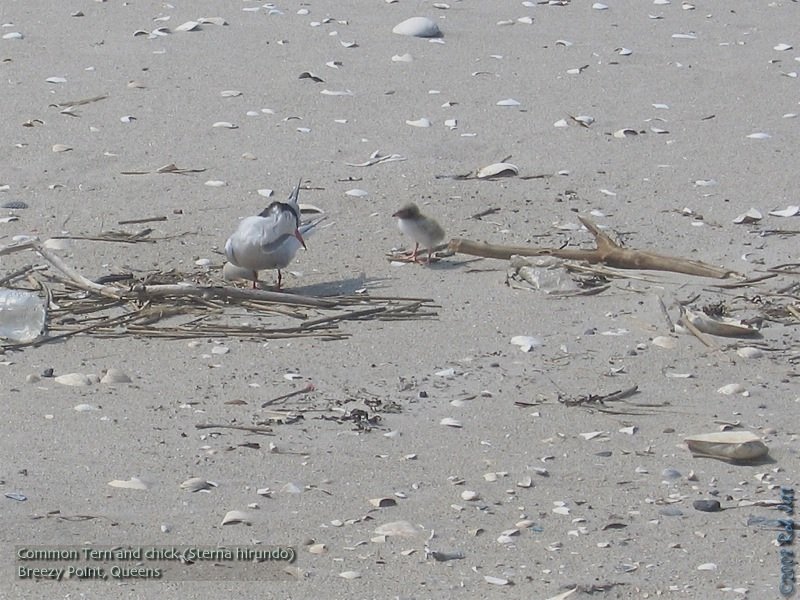
At the Breezy Point Cooperative beaches there were hundreds (possibly thousands) of pairs of nesting Common Terns. Residents of the cooperative have erected wood and string "arbors" above the beach access walkways to protect themselves from very aggressive parent terns. In my experience, most dive-bombing by Common Terns is purely for show and they rarely actually strike people. Near the edges of the dunes we found young terns in various stages of development. Some appeared to be recently hatched while others were already fledged and the size of their parents. Families of American Oystercatchers could be heard squealing up and down the beach, while Black Skimmers silently flew across the dunes towards the bay.

By 4pm the wind had picked up and was gusting out of the southwest. Sunbather's blankets were disappearing under sand drifts and the tiny, blowing grains were stinging my legs. As we headed north towards the bridge, I commented that the strong tailwind would make our return trip very quick.

I was nearly at the center of the bridge when I was startled by a cyclist passing me on my left. The pedestrian path is very narrow and it is common courtesy (not to mention safer) to alert a fellow cyclist when you are passing. Moments later he was followed by a young woman. I angrily shouted to her that she should warn people when passing. Once passed the peak of the roadway, I leaned way down on my handlebars and positioned my pedals parallel to the ground. There was a dangerous crosswind blowing off the water and I was attempting to decrease my wind resistance.

The young woman who had passed me a few minutes earlier was a couple of hundred yards ahead when I saw her go down. My guess is that a gust of wind caught her by surprise. Her front wheel jerked to the right, she overcompensated, then flipped off the bike.

She had terrible abrasions on her forearms, knees and chest. Her mouth and nose were bleeding as was a bump that was forming on her forehead. She never lost consciousness but was bleeding a lot. I told her to sit down and used my cellphone to call 911. Paige asked if the young man who also passed us was her boyfriend. She nodded her head, "yes". He had been traveling so fast that he was out of sight and probably wondered about his missing girlfriend. Paige gave her some tissues to hold on her head, then took off on her bike to find the girl's companion. While waiting for the ambulance to arrive, I stood in the pathway and signaled to approaching cyclists to slow down. Several people offered more napkins and other assistance.

It seemed to take forever, but eventually a bridge construction vehicle with a large flashing yellow arrow arrived to block access to the near lane. A few minutes later the ambulance pulled up. A pair of New York's bravest hopped over the railing and onto the pedestrian path. They quickly attended to the young lady. Paige held her hand and reassured her that everything would be fine. I just tried to stay out of the way and direct bike traffic. In addition, despite the shock, pain and blood, I managed to get a laugh out of her, which is an important part of emergency medical treatment. She didn't appear to have any broken bones, just a lot of road-rash. Incredibly, she hit her face hard enough to have sustained two fat lips, a bloody nose and a knot on her forehead, but didn't knock out any teeth.

Paige and I stayed until the EMTs wheeled her down the path to the toll plaza, where they could access the roadway and place her in the ambulance.

Now for my brief lecture:

Neither she nor her boyfriend were wearing helmets. I pointed out to both of them that most people don't get a second chance after they fly off their bicycle and hit their head! I wish her a speedy recovery and hope to see her out cycling someday, but wearing a really stylish helmet.

by Rob Jett for "The City Birder"