Check out my Green-Wood sponsored tours on their calendar pages here. You can also find me on Bluesky here
Celebrate your inner nerd with my new t-shirt design! Available on my Spreadshirt shop in multiple colors and products.
Showing posts with label Weekly Highlights. Show all posts

Sunday, January 14, 2024

Week 2 - Green-Wood Cemetery

The second week of the year was punctuated by a couple of days of torrential rains followed by gusting winds. Neither are my favorite conditions for wandering around outdoors. I did manage to get into the cemetery for a bit and there was one very noticeable change since the previous week.

Despite the appearance of increased aggression between our local Red-tailed Hawks, it is merely their annual courtship displays. There are several pairs in the area and it is the time of year when they strengthen their bonds through mock battle.


Listen for their familiar, hoarse "kee-eeeee-arr" calls and watch as they circle, dive and, occasionally, lock talons.

I recently spotted an immature Red-tailed Hawk practicing collecting branches for nest building. While  red-tails that haven't attained their namesake red tail yet can actually still breed, it is somewhat rare. This individual didn't appear to be trying to impress a potential mate, but rather was mostly just pulling bark and branches from various trees, then dropping them as he flew off. While watching, I met a woman named Sara with her young daughter near Battle Hill. I pointed out the hawk to them and they joined me for the show. He was so focused on this pointless task that he completely ignored his audience of three. I reassured Sara and her daughter that they had nothing to fear from this silly hawk. The front row seats to the close encounter is something I'm certain that they won't forget.


Monday, April 10, 2023

Familiar Silhouettes

I've been creating a series of high contrast, silhouette bird photographs lately. What began as subjects in terrible lighting conditions became, well, something a bit more interesting. I'll continue to add to this posting over time, so check back again:

Northern Flicker, Green-Wood Cemetery, Brooklyn, NY

House Finch, Green-Wood Cemetery, Brooklyn, NY

Fish Crow, Sheepshead Bay, Brooklyn, NY

Merlin, Green-Wood Cemetery, Brooklyn, NY

Red-tailed Hawk, Green-Wood Cemetery, Brooklyn, NY

Carolina Wren, Green-Wood Cemetery, Brooklyn, NY

American Goldfinch, Green-Wood Cemetery, Brooklyn, NY

Ruby-throated Hummingbird, Floyd Bennett Field, Brooklyn, NY

Great Blue Heron on top of a larch, Green-Wood Cemetery, Brooklyn, NY

Double-crested and Pelagic Cormorants, Yachats, OR

American Robin, Green-Wood Cemetery, Brooklyn, NY

Mourning Dove, Green-Wood Cemetery, Brooklyn, NY

Hawk food, Mt. Olivet Cemetery, Maspeth, NY

Summer Tanager, Green-Wood Cemetery, Brooklyn, NY

Boat-tailed Grackle, Shirley Chisholm SP, Brooklyn, NY

Brown Creeper, Green-Wood Cemetery, Brooklyn, NY

Fighting Red-tailed Hawks, Green-Wood Cemetery, Brooklyn, NY

Fish Crow, Shirley Chisholm SP, Brooklyn, NY

Sharp-shinned Hawk, Green-Wood Cemetery, Brooklyn, NY

Gray Kingbird, Great Kills Park, Staten Island

Fox Sparrow, Green-Wood Cemetery, Brooklyn, NY

Great Egret, Green-Wood Cemetery, Brooklyn, NY

Dark-eyed Junco, Green-Wood Cemetery, Brooklyn, NY

European Starling, Green-Wood Cemetery, Brooklyn, NY

Mourning Dove, Green-Wood Cemetery, Brooklyn, NY

American Kestrel, Green-Wood Cemetery, Brooklyn, NY

Northern Mockingbird, Green-Wood Cemetery, Brooklyn, NY

Yellow-billed Cuckoo, Green-Wood Cemetery, Brooklyn, NY

Great Blue Heron, Green-Wood Cemetery, Brooklyn, NY

Immature Green Heron, Green-Wood Cemetery, Brooklyn, NY

Glossy Ibis, Jamaica Bay Wildlife Refuge, Queens, NY

Osprey with fish, Green-Wood Cemetery, Brooklyn, NY

Red-tailed Hawk, Green-Wood Cemetery, Brooklyn, NY

Eastern Phoebe, Green-Wood Cemetery, Brooklyn, NY

House Wren, Green-Wood Cemetery, Brooklyn, NY

Downy Woodpecker, Green-Wood Cemetery, Brooklyn, NY


**********

Tuesday, January 18, 2022

Green-Wood Cemetery: Week 2

Week two in Green-Wood Cemetery and any seasonal changes are subtle, if discernible at all.

"Jelena" Witch Hazel, a cross between Japanese witch hazel (H. japonica) and Chinese witch hazel (H. mollis), has begun unfurling its spindly, ribbon-like petals. It will be at least another month before we see the more familiar yellow blossoms of the native Hamamelis vernalis.

Many species of roses around the cemetery are heavy with rosehips. However, the birds are primarily feeding on holly and yew berries right now, so it won't be until those sources are exhausted that they start eating these fruits.
Not really a source of food for the local wildlife, these Pussy Willow (salix discolor) are merely a feast for my eyes.
Not certain if this is a cypress or juniper as both can have blue fruit. Whichever it is, these Northern Cardinals were taking a break from the red fruits to snack on the abundant berries. I frequently find cardinals in winter at the tops of tuliptrees eating the small nut at the base of the seed spikes.
Mourning doves have begun gathering in flocks on the sunny slopes of the Dell Water. In addition to the "safety in numbers" aspect of this behavior, the thick leaf litter here likely holds an abundance of food.
If you hear a mewing call from the treetops, it's not a stuck cat. The Yellow-bellied Sapsucker is a common winter visitor who's typical vocalization is more reminiscent of a feline than a bird. Look for evenly spaced, horizontal rows of holes to discover a favorite feeding spot.
Roving flocks of Blue Jays have an extremely varied diet. Feeding on everything from acorns to insect larvae, they are intelligent opportunists. These sometime mimics will often imitate Red-tailed Hawks when near bird feeders to clear the area, then monopolize the feeding station.
With little in the way of cover in winter, any small bird is a target for the local American Kestrels. This Blue Jay-sized raptor will hunt insects, as well as, rodents and small birds. Hill-of-Graves is a good spot to look for them.
This young Red-tailed Hawk is giving me the evil eye because he's clutching a freshly killed squirrel in his talons. The resident red-tails should be courting now and beginning their annual nest building activity.

Thursday, December 09, 2021

Friday's Foto


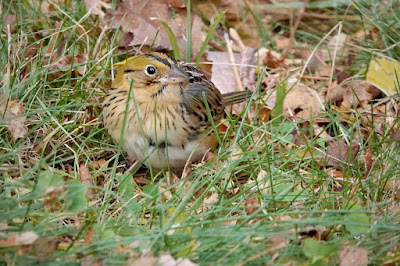
Henslow's Sparrow, Green-Wood Cemetery, Brooklyn, NY
This will be an extended "Friday's Foto" posting, given the rarity of this species in Brooklyn and state-wide. A recent visitor to historic Green-Wood Cemetery marked a first for that spot. The previous record for Brooklyn was 48 years ago.

The Henslow's Sparrow is probably one of North America's loveliest sparrow with its olive-green head, orange lores, scaley coverts with purple highlights, rusty red primaries, buffy breast with fine, dark streaks and bright, white eyering. Previously classified in the genus Ammodramus with other grassland species, in 2018 it was reclassified into "centronyx" with the Baird's Sparrow. The name means "spurred claw" which refers to these birds' long hind toes. John James Audubon gave this bird its common name for his friend, John Stevens Henslow, a botanist, a minister, and a teacher of Charles Darwin.

This specie's decreasing population in New York State, as well as, its skulking behavior make it very difficult to observe. In their preferred habitat of thick, weedy grasslands and wetlands, this bird forages alone, usually not in flocks of Henslow's or other sparrows. They spend their time walking in dense grass while foraging and, if flushed, reluctantly fly low a short distance then drop back down into the vegetation. More often then not, they will flee perceived threats by running. In addition, James D. Rising, author of "A Guide to the Identification and Natural History of the Sparrows of the United States and Canada", notes of this bird's behavior, "Migrants are reluctant to flush, and can be approached closely." Their diet consists primarily of insects and seeds. Assessed in 2020 by the IUCN, they rate their global status as "Least Concern". That is up from "Near Threatened" in 2016. However, populations in New York State have been declining, prompting the NYSDEC to list it as "Threatened".

The Henslow's Sparrow's breeding range includes New York, southern Ontario, Michigan, Wisconsin, Minnesota, Iowa, Nebraska, Kansas, Oklahoma, Missouri, Illinois, Indiana, Kentucky, Tennessee, Ohio, West Virginia, and Pennsylvania. They overwinter from the Gulf Coast of Texas east into the northern two-thirds of Florida and north into North Carolina. There are infrequent records north into the Midwest and Middle Atlantic states.

This sparrow has one of the simplest song of any North American species. Its high, thin "tze-lick" was described by David Sibley as a "feeble hiccup." Judge for yourself. Be sure to turn up the volume:


Finally, here's a video I shot in Green-Wood Cemetery on Tuesday, December 7, 2021: